
Tracking Difference vs TER:
what you should actually compare
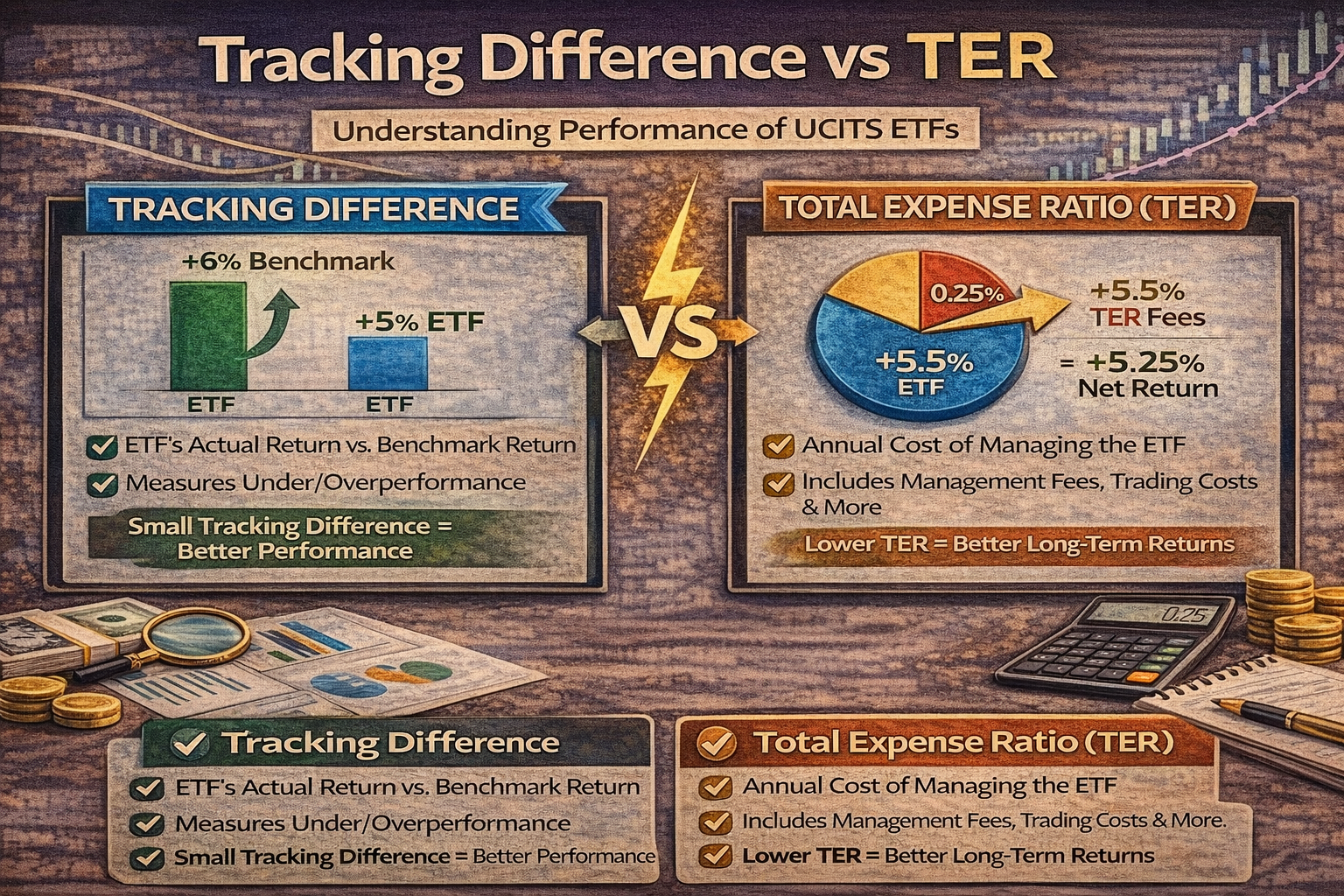
TER is a label. Tracking difference is the result. Two ETFs can share the same stated fee and still diverge in real-world drag — because TER ignores how the fund is actually run.
Some of the links on this site are affiliate links, meaning we may earn a commission at no extra cost to you if you sign up through them. This does not affect our reviews or recommendations — we only feature products we genuinely believe are useful for investors. This site provides educational content only, not personalized investment advice. Investments can lose value and past performance does not guarantee future results. You are responsible for your own financial decisions and for confirming the tax and legal rules that apply in your country.
TL;DR
- The full outcome: ETF return minus index return.
- Includes TER, trading costs, tax drag, and cash.
- Securities lending can offset costs — TD shows the net.
- Measurable over time, not a marketing figure.
- Rebalance and trading costs inside the fund.
- Withholding tax drag (depends on domicile and treaty).
- Cash held for redemptions and dividend timing.
- How well (or badly) sampling is executed.
TER, tracking difference, and tracking error — clearly defined
These three terms are often used interchangeably. They mean different things, and confusing them leads to bad comparisons.
| Term | What it is | Use it for |
|---|---|---|
| TER | Stated annual fee — a label published by the fund | First-pass filter only |
| Tracking difference | ETF return minus index return over a period — the actual gap | Primary comparison metric |
| Tracking error | Volatility of the tracking difference — how stable the match is | Secondary / operational signal |
Six things TER doesn’t capture
The gap between TER and actual tracking difference comes from how the fund is operated day-to-day. These are the usual drivers.
Index rebalances, corporate actions, and cash flow management all generate internal turnover that isn’t captured in TER.
Dividend tax treatment depends on fund domicile, treaty access, and the index’s return series. This can easily dwarf small TER differences for equity ETFs.
Holding cash to manage inflows, redemptions, or dividend timing creates small but persistent lag versus the fully-invested index.
Revenue from lending can offset costs and actually improve tracking difference — but policies vary significantly by fund. It’s a positive drag-reducer, not a risk-free bonus.
Funds that use optimised sampling (rather than full replication) can diverge from the index depending on how well the sample is constructed and maintained.
Comparing an ETF against the wrong return series (price vs net vs gross total return) creates fake alpha or fake drag. Comparisons must use the exact same benchmark series.
Comparing tracking difference correctly
Most “comparisons” use the wrong benchmark series, wrong currency, or too short a window. These rules prevent all three mistakes.
| Rule | Why it matters |
|---|---|
| Match the exact benchmark series | Price return, net total return, and gross total return give different numbers — use the same one for both ETF and index |
| Use total return for the ETF | For distributing ETFs, include reinvested dividends. For accumulating, use NAV total return. Mixing these creates false gaps. |
| Keep currency consistent | Comparing an ETF in EUR to a USD-denominated index mixes FX noise with tracking performance |
| Use a 3–5+ year window | One-year figures are distorted by dividend cycles, timing, and index rebalance events |
| Use official sources | Provider factsheets and annual reports are more reliable than third-party screeners that may use inconsistent methodologies |
Consistently small negative tracking difference over 3–5+ years — close to TER, or better if lending revenue offsets costs. Year-to-year stability matters too.
Persistent underperformance larger than TER, or gaps that widen unpredictably in volatile periods without a clear structural explanation.
Before you pick an ETF — two-part check
Tracking difference tells you which fund is better-run. Your execution costs determine how much of that advantage you actually keep.
- Same index? Same return series (net/gross/price)?
- Tracking difference over 3–5 years from official source.
- Replication method: physical (full or sampling) vs synthetic.
- Securities lending policy — does revenue go back to the fund?
- Fund size and typical bid-ask spread on primary listing.
- Distribution policy aligned with your tax situation.
- Broker FX costs — often bigger than TER differences.
- Use limit orders for ETFs with meaningful spreads.
- Avoid frequent micro-buys if spreads and FX are wide.
- Buy on the primary listing / best-liquidity exchange.
- Consider multi-currency accounts to avoid repeated conversion.
Common mistakes that invalidate the comparison
| Mistake | Why it’s a problem |
|---|---|
| Wrong benchmark series | Comparing to price return vs net total return creates false gaps that don’t reflect fund quality |
| Different currency bases | You end up measuring FX movement, not tracking performance |
| 1-year window only | Short windows are dominated by timing noise — dividend cycles, rebalances, single large events |
| Ignoring spreads and FX | Your personal execution drag can easily exceed the difference you’re trying to optimise for |
| Assuming “lowest TER wins” | Operations, tax efficiency, and lending can beat a lower sticker fee — only tracking difference shows the net |
| Comparing acc vs dist wrong | Mixing price return on a distributing ETF with NAV return on an accumulating one creates a false performance gap |
Pick the better ETF — then reduce execution drag
Tracking difference helps you choose between funds. Your broker determines how much of that edge you keep. IBKR gives you multi-currency control and institutional FX rates — the lowest-drag setup for European ETF investors.
Go deeper
Frequently asked questions
Is tracking difference always negative?
Usually slightly negative, but it can be close to zero or even positive in some periods if securities lending revenue and efficient execution offset costs. Long-run consistency matters more than any single year — look for a stable, narrow gap over 3–5+ years, not just the latest figure.
Should I always pick the ETF with the lowest TER?
No. TER ignores trading costs, tax handling, cash drag, and operational quality. Two ETFs can share the same TER and diverge significantly in real-world tracking difference. Use tracking difference as the primary outcome metric — TER is a starting point, not a conclusion.
What time window should I use when comparing tracking difference?
Prefer 3–5+ years where data is available. Short windows can be distorted by dividend timing cycles, index rebalances, and single-period noise. If an ETF is new and you only have 1–2 years of data, treat it as tentative rather than conclusive.
Do accumulating ETFs have different tracking difference than distributing ones?
They can, mainly due to dividend timing and reinvestment mechanics. The key is to use total return figures consistently — never compare a distributing ETF’s price return to an accumulating ETF’s NAV return, as this creates a false performance gap unrelated to either fund’s quality.
Does my broker choice affect my real returns?
Yes — but separately from the fund’s tracking difference. Your broker determines your execution drag: FX conversion costs, bid-ask spreads at purchase, and order quality. These layer on top of the fund’s tracking difference. For smaller portfolios or frequent purchases, broker FX costs can easily exceed the tracking difference gap you’re trying to optimise for.
QuantRoutine provides educational content only. Nothing on this page is an offer, solicitation, or recommendation to buy or sell any security or fund. Investments can lose value and past performance does not guarantee future results. Tax treatment of ETFs varies by country and by fund domicile. You are responsible for your own investment, tax, and legal decisions. Always review each fund’s current KID/factsheet and each broker’s current terms before acting.